Industry
Home ServicesHow we replaced a site that needed a developer for routine updates with eight purpose-built content types and a promotions system that manages itself
Somewhere on the internet right now, a home services company is advertising a discount that expired fourteen months ago.
Not because anyone is careless. Because taking it down required someone to remember it existed, find it in a list of a thousand pages, and know which of three similar-looking entries was the live one. That is not a content problem. It is a development problem, and it is the kind that never makes it into a redesign brief.
Our client, a large regional home and facility services contractor, came to us with a website that looked fine and worked badly for the people who had to operate it. Every recurring task, from launching a seasonal promotion to adding a new service market, required either a workaround or a phone call to a developer. We built the replacement around a single question: what does this team do over and over, and why are they doing it by hand?
Table of Contents
At a glance
- Eight purpose-built content types, each replacing a pattern the team had previously rebuilt manually every time
- A self-managing promotions system handling recurring monthly offers and automatic expiry, so nothing outlives its end date
- Templated location pages, so entering a new market publishes a full service set
- Gated content with email capture built into the CMS rather than bolted onto it
- A content taxonomy rebuilt from the ground up, turning years of inconsistent categorization into a filter set people can actually scan
- The real deliverable: a marketing team that can run the site a year after launch without calling the agency

The problem: a website nobody could operate
The content audit is where this became obvious. Going URL by URL through the existing site, a pattern kept surfacing that had nothing to do with design or copy.
Expired promotional pages were still live and indexed, some of them well over a year old, competing in search with active offers. Pages built for a single paid campaign or event had quietly become permanent. Similar content existed in three places because it was easier to build a new page than to find the old one.
This isn’t a reflection of the people managing the website. It’s a reflection of a system that made the correct action harder than the incorrect one. When a busy team finds that taking a page down is more work than leaving it up, pages do not come down. When the CMS has a single generic page type, everything becomes a generic page, and a thousand generic pages is not a content library. It is a haystack.
A cleanup effort and redesign would fail within a year if it shipped on the same structural foundation.
Promotions: the feature that proves the point
Promotions are the perfect test case, because they are simultaneously trivial and constant.
This client runs offers that behave in genuinely different ways. Some recur every month with new terms. Some run once with a fixed end date. Some refresh at month end with no fixed schedule at all. Under the old system, all three were the same thing: a page somebody made, and a page somebody had to remember to unmake.
We built promotions as their own content type with expiry as a first-class property rather than an afterthought. Recurring offers are handled as recurring, so the monthly cycle does not generate a fresh page and a fresh cleanup task every thirty days. One-off offers carry an end date and unpublish themselves when they reach it. Slugs are managed by the system rather than improvised, so a returning seasonal offer does not collide with last year’s version or spawn a near-duplicate URL.
The behavior that matters most is what happens automatically. An offer that ends stops being a live page without anyone taking any action. It is a small piece of engineering that quietly eliminates a recurring failure mode. It is the sort of thing that easily goes unnoticed, which is exactly the point.
Promotions also surface in more than one place. They appear on the homepage and on individual market pages, meaning each promotion is a single record rendered in multiple contexts. Change it once, and it is correct everywhere.
Eight content types, eight recurring problems
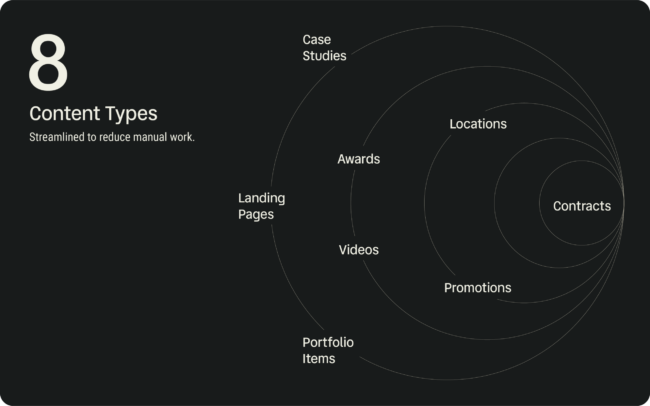
Promotions were one of eight. Each content type in the build exists for the same reason: a pattern kept recurring, and the team was reproducing it by hand.
| Content type | The pattern it replaced |
|---|---|
| Promotions | Manual creation and manual removal of every offer |
| Locations | A new market meant a batch of hand-built pages |
| Awards | Recognitions scattered across unrelated pages with no consistent display |
| Case studies | Proof content with no home, so it lived in whatever page needed it |
| Portfolio items | Project work rebuilt from scratch for each presentation |
| Contracts | Procurement and vehicle information buried in prose |
| Landing pages | Campaign pages built as permanent site pages |
| Videos | Media embedded ad hoc with no reusable record |
The discipline here is knowing when not to build one. A custom content type is a commitment. It carries fields, templates, and editorial training. Each of these eight earned its place by appearing repeatedly in the audit, which is the argument for doing a full content inventory before writing any code.
Landing pages are worth calling out specifically. Campaign pages had previously been built as ordinary site pages, which meant they inherited site navigation, accumulated in the sitemap, and competed in organic search against the pages meant to rank. Giving them their own type let them behave the way campaign pages should: purpose-built, tracked separately, and deliberately kept out of the organic index.
Locations: one template, every market
Location pages run on templates, with services nested underneath each market. Adding a new market does not mean building a set of pages. It means creating one record, after which the full service lineup exists for that market automatically, correctly structured and correctly linked.
Before, growth created work. Every new market multiplied against every service line, and the marketing team absorbed that multiplication by hand. After, growth is a straightforward data entry task. That gains compound every single time the company expands.
Gated content without a separate platform
The client wanted downloadable resources behind an email capture, and the default answer to that request is usually a third-party marketing platform, a new subscription, and a form that looks like it came from somewhere else.
We built it into the CMS instead. A compact content block pairs the resource with a capture form, submission triggers the client’s own email automation, and the automation delivers the asset from the media library. The client owns the list, the styling matches the site because it is the site, and there is no monthly fee for a form. We also built a mechanism to track how often users accessed the gated content.
The resource library: untangling years of categories
The resource section needed to filter along three independent dimensions: audience, service line, and content format. The biggest challenge was that the existing categorization had drifted for years.
Categories had been used interchangeably to mean topics and to mean services, so the same vocabulary was doing two incompatible jobs. Individual posts carried as many as six categories. Filtering that as-is would have produced a control panel rather than a resource library.
The fix was structural, and happened before the interface was built. The taxonomy was split apart so topics and services stopped competing, then consolidated and reapplied across the archive. Content format is surfaced visually on each card rather than adding another control, since every item has exactly one format and a filter for it would be redundant.
What “done” means for a development team
The measure of success for this build is not what it looked like on launch day. It is whether, twelve months later, a marketing coordinator who was not in any of the planning meetings can add a market, run a seasonal offer, publish a case study, and retire a campaign without opening a support ticket. That is the standard we build to, and it is why the content inventory phase gets as much attention as the visual design phase.
Development that only serves the launch is a rental. Development that serves the team is an asset.
Why this kind of web development work matters
The failures a CMS creates are slow and hard to attribute. Expired offers stay live. New markets take three weeks to launch instead of an afternoon. Proof content never gets published because there is nowhere to put it. Nobody logs a ticket for any of it. The site just gradually stops reflecting the business.
Nobody sees good CMS architecture, which is the reason it is chronically underscoped. But it determines whether a redesign is still accurate two years later or has quietly reverted to the mess it replaced.
Need a website your team can actually run?
If routine updates on your site require a developer, the problem is usually not your team. It is a content system that was designed for a launch rather than for the years afterward.
Astute builds websites on content architecture shaped around what your team does repeatedly, so the routine work stays routine and growth does not create a backlog.
Good to Know
FAQs About CMS and Content Architecture
When does content justify a custom content type?
When the pattern recurs and carries consistent structured fields. Locations, promotions, and case studies almost always qualify because each one has the same shape every time. A pattern that appears twice does not qualify. Every content type carries template, field, and training overhead, and building one speculatively costs more than it saves.
How should promotional and seasonal content be handled?
With expiry treated as a property of the content rather than a task on someone’s calendar. Recurring offers should be modeled as recurring, one-off offers should carry an end date and unpublish themselves, and slugs should be system-managed so returning seasonal offers do not collide with prior versions. Any promotions setup that depends on a person remembering will eventually fail.
Should campaign landing pages live in the main site structure?
No. Campaign pages built as ordinary site pages inherit navigation, accumulate in the sitemap, and compete against the pages meant to rank organically. Giving them a separate content type lets them be tracked separately and kept out of the organic index without extra effort at build time.
How do you build location pages that scale?
Templates, with services nested under each market. Adding a market should be a single record that generates the full service set. Service-first structures multiply badly, because each new service adds work across every market and each new market adds work across every service.
Should content taxonomy be decided before or after design?
Before. The number of filter dimensions and how they combine determine the entire interface of a resource section. Cleaning up years of inconsistent categorization after the interface exists means designing and building that section twice.