Services
Website DevelopmentHow we merged more than six thousand URLs across nine separate properties into a single site, without breaking the path a person in crisis takes to find help
Our behavioral healthcare client operated nine separate websites. There was a main domain, plus standalone properties for eight different locations, and a distinct sub-brand. Each had years of accumulated content, its own blog archive, its own redirect history, and its own set of pages ranking for the queries that bring people to treatment.
Consolidating them into one domain was the right strategic call. Executing it was a coordinated effort measured in thousands of individual decisions, in a regulated industry where the wrong page going dark has consequences beyond a traffic dip.
Table of Contents
At a glance
- 6,226 URLs inventoried across the nine properties before a single redirect was written
- Every URL evaluated individually against real traffic, not bulk-mapped by pattern
- 1,756 pages retired and redirected, 290 near-duplicate articles merged into single authoritative pages, 100 kept untouched
- A dedicated redirect map for 203 drug information pages, treated separately because of how people reach them
- 400+ legacy redirects inherited and imported, preserving paths that predated our involvement
- Regulatory constraints built into the launch sequence, including LegitScript certification timing and a compliance language sweep
- Fifteen self-assessment tools rebuilt with results delivery and follow-up automation

The problem: a brand competing with itself
Nine websites for one organization means nine sets of everything. Nine privacy policies. Nine contact paths. Nine blog libraries with substantial topic overlap, because each regional site had independently written about alcohol withdrawal, detox timelines, and insurance coverage.
For the organization, that meant nine properties to maintain and update, with no consistent single source of truth to inform users, search engines, or LLMs.
The consolidation had to preserve every path that worked while eliminating redundancy. Those two goals pull against each other constantly, and the entire project strategy was driven by that tension.
The redirect work
This is the part of a migration that determines whether it succeeds, and it is almost always underestimated.
Every URL got evaluated individually. The redirect maps were built per property, and each row carried the URL, its actual traffic over the prior 28 days, a keep-or-redirect decision, a destination, a content action, and a page-type classification separating administrative pages from treatment and program pages, location pages, campaign pages, and blog posts.
That structure exists because destination choice depends on what a page is. A location page that no longer exists should land somewhere geographically relevant. A retired treatment page should land on the program that replaced it. A dead campaign page should not land on a service page at all. Bulk-mapping by URL pattern gets all three wrong.
Granular over bulk, deliberately. The alternative was tempting. Bulk rules would have collapsed thousands of URLs in an afternoon. Technical Delivery Director Rob Petrin and Digital Marketing Director Craig Haller pushed hard against it for a specific reason: bulk redirects create chains and loops. A URL redirecting to a URL that redirects again is slower for every visitor, degrades over time as more rules stack up, and eventually produces loops that fail entirely. Granular mapping guided by traffic is more work up front, and is the only approach that stays clean.
Legacy redirects were inherited, not discarded. The old sites carried years of accumulated redirect rules, many of them pointing at pages that had already moved once or twice. We imported more than 400 of them so that paths established long before our involvement continued to resolve. A person following a link from a five-year-old forum post still arrives somewhere useful.
Drug information pages got their own map. Two hundred and three of them, handled separately from everything else. These pages get reached differently than service pages, often through very specific searches at moments of acute concern, and folding them into a general rule would have produced destinations that made no sense to the person arriving.
Merging, not just moving
Additional work revolved around content that existed in multiple places.
Roughly 290 articles across the nine properties covered overlapping topics. A basic approach is to pick the version from the main site and redirect the rest. Our content team did more: for each cluster, identify the version that actually performed best regardless of which property it lived on, use that as the baseline, merge the substance of the others into it, and redirect everything to the survivor.
That distinction matters. Sometimes the best version of an article lived on a small regional site. Defaulting to the primary domain could have thrown away the better asset and kept the weaker one.
Alongside that, 100 articles were identified as strong and unique and moved without edits, and 1,756 pages were marked for removal: thin content, duplicates, and pages built around topics that had no business on a treatment provider’s website. Retiring content is a real deliverable.
Building for a regulated industry
Behavioral health is not a typical development environment, and two constraints shaped this build directly.
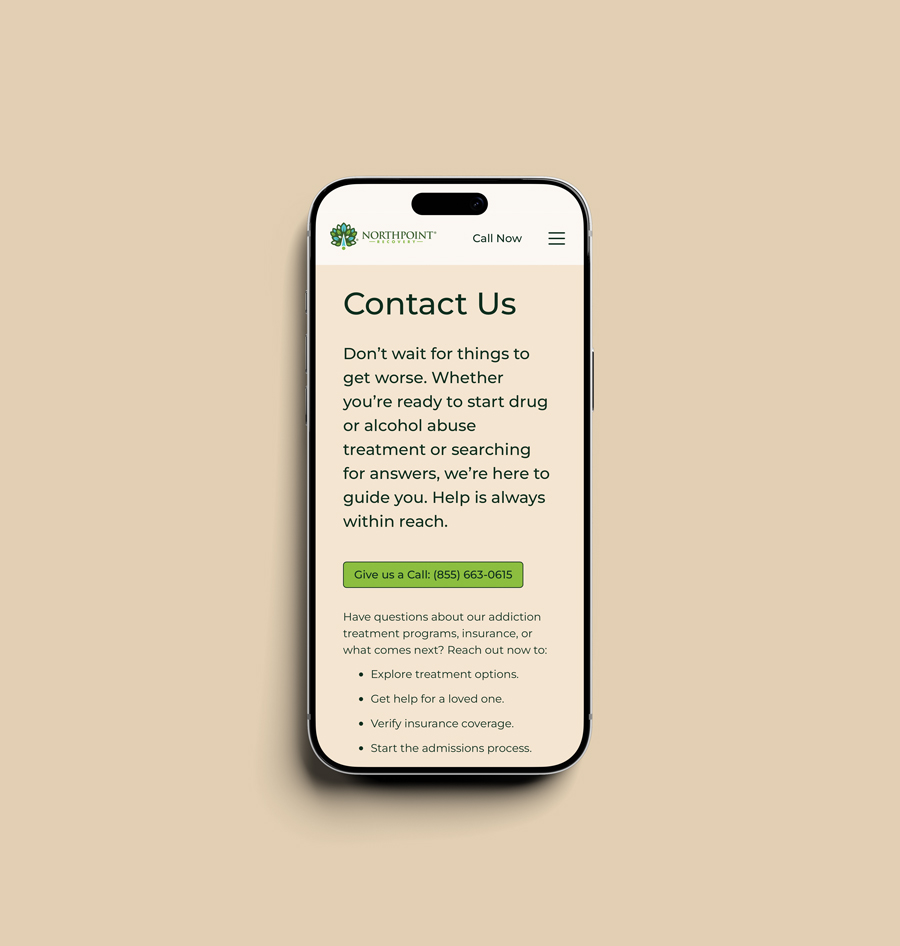
LegitScript certification drove the launch sequence. Addiction treatment providers cannot run paid search without LegitScript certification, and certification cannot begin until the new site is live. That creates a hard dependency: the moment you launch, your paid acquisition pauses until approval comes through. Treating it as just a marketing team’s problem is how migrations end up strangling a client’s admissions pipeline for a month. Launch timing was planned around it explicitly.
Compliance language had to be scrubbed at the source. Certain promotional framings common in the broader industry, including offers of complimentary or free assessments, are restricted. We identified 83 pages across all eight satellite domains carrying that language and remediated them as part of the migration. Doing it during the move meant it happened once, on pages already being touched, instead of becoming a separate cleanup project against a live site.
Underneath both: this is a category where people disclose sensitive health information about themselves and their families. Every form, every information capture point, is subject to HIPAA compliance. The site was built with that in mind, because the cost of getting it wrong is effects everyone.
The assessment tools
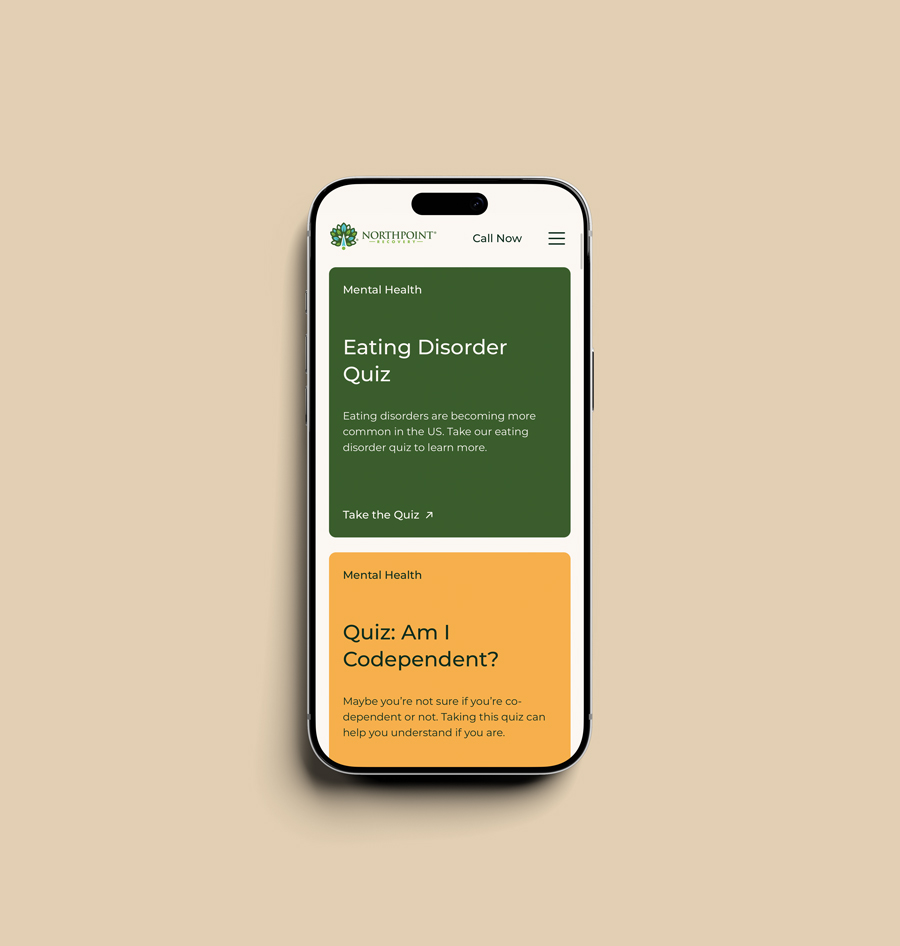
We built a set of fifteen self-assessment quizzes, organized into three groups.
Mental health assessments cover codependency, eating disorders, professional addiction, and trauma. Substance-specific assessments cover alcohol, cocaine, crystal meth, general drug use, functional alcoholism, heroin, and prescription drugs. Treatment assessments help someone work out whether they need detox, whether they need rehab, whether they may be dealing with a dual diagnosis, and how addiction is affecting their family.
The engineering brief here was unusually delicate. Someone taking one of these is often at the earliest stage of admitting there is a problem, and the interface has to be honest about what it is (and is not). The tools are explicitly framed as a step toward a conversation rather than a diagnosis, and that framing is built into the flow rather than buried in a disclaimer.
Mechanically, each assessment captures a submission, delivers results to the person by email, and triggers a follow-up sequence with information about treatment options. The email step is doing real work: it gives the person their results in a place they can return to privately, on their own schedule, rather than forcing a decision in the moment. That is a better experience and a better conversion mechanism at the same time, which is rare.
Launch is not the finish line
Post-launch, audits surfaced two categories of problems, and the response to each says something about how we run migrations.
404s from legacy paths. The old main site carried hundreds of legacy pages that could not be edited directly, along with UTM-tagged URLs and redirect rules stored in various locations. Rather than adding blanket rules to make the errors disappear, each was traced to its actual source and mapped individually, and internal links were updated at the source rather than propped up with another redirect. Fixing a broken internal link is permanent. Redirecting around it adds a hop that every future visitor pays for.
Over 700 missing images. Our post-launch audit surfaced a significant number of older blog posts with missing images. Rob’s fix was to pull all static images across with their URLs preserved one-to-one, so the existing references in post content resolved without anyone editing hundreds of articles by hand. The alternative would have been weeks of manual content updates.
A migration of this size will surface issues after launch, always. What distinguishes a good one is whether there is a planned audit cadence to find them and whether the fixes are structural or cosmetic.
Why this kind of development work matters
A consolidation can be a high-risk prospect for existing websites. You are deliberately dismantling properties that work, in the hope that what replaces them works better. Everything depends on execution that nobody will ever see.
For a behavioral health provider, the stakes are real. Every broken path is a person who searched for help, hit an error, and did not try again. The redirect map is the list of every route someone might take to reach treatment, and the job is making sure all of them arrive at the help they need.
Planning a site consolidation or migration?
If you are running multiple domains, or you are about to merge, rebrand, or replatform, the redirect strategy is not a launch-week task. It is the project.
Astute plans and executes website consolidations and migrations for regulated and high-stakes industries, with URL-level mapping, inherited-redirect preservation, and post-launch audit cadences built into the scope from the start.
Good to Know
FAQs About Website Consolidation and Migration
Should we consolidate multiple regional websites into one domain?
Often, yes, if they represent one organization. Separate properties mean duplicated maintenance, duplicated content, and a fragmented experience for anyone who encounters more than one of them. Disparate websites can dilute the brand and make it harder for users, search engines, and LLMs to decipher who you are.
The caveat is that consolidation is only worth doing if the migration is executed properly, because a poorly run one costs more than the fragmentation did.
Can redirects be handled in bulk?
Not safely at scale. Pattern-based rules produce chains and loops, which slow every request and eventually fail outright. They also pick destinations that make no sense, because the right destination depends on what a page was, not what its URL looked like. Granular mapping guided by actual traffic is more work, easily justified as it creates more value.
What happens to redirects that already existed on the old site?
Import them. Legacy rules represent paths established over years, and links pointing at them still exist across the web in places you cannot control. Discarding inherited redirects is one of the most common and most invisible ways a migration loses value.
How do you decide which version of duplicated content survives?
By performance, not by which property it lived on. When several sites cover the same topic, identify the best-performing version regardless of source, merge the others into it, and redirect everything to the survivor.
What should happen after launch?
A planned audit cadence, not just a one-time check. Large migrations surface 404s, missing assets, and orphaned pages in the weeks following launch. Expecting that is different from being surprised by it. Fix problems at the source where possible, since a redirect that patches a broken internal link is a cost every future visitor pays.
Are there development considerations specific to healthcare or regulated industries?
Yes, and they affect timing as much as code. Certification and compliance reviews often cannot begin until a site is live, which creates dependencies that need to be planned around. Restricted promotional language should be remediated during migration, on pages already being touched, rather than as a separate project afterward.