
Services
SEOBuilding a telehealth search presence that matches how care actually works: state by state, service by service
Telehealth changed how behavioral health treatment is delivered. It didn’t change how it’s licensed.
Our client, the outpatient arm of a nationally recognized behavioral health treatment provider, offers a virtual intensive outpatient program (IOP): structured, clinician-led addiction and mental health treatment delivered by telehealth. The care is virtual, but the rules aren’t. Clinicians must be licensed in the state where the patient lives, so a person in Houston searching for a virtual IOP can only enroll in a program licensed for Texas.
Their website, though, had a single national virtual IOP page. One page was trying to serve searchers in every state, competing against providers who spoke to each state directly. Google had the same problem patients did: no way to know where this program could actually help.
So we rebuilt the program’s search presence the way the program itself works: state by state.
Table of Contents
At a glance
- A hub-and-state architecture for the virtual IOP program: a national hub page, state pages, and state-specific service pages for addiction treatment and mental health treatment
- Launched May and June 2025, expanding to cover Texas, California, Georgia, Illinois, Colorado, and more
- One year on, quarterly organic clicks to the section are up 149% (703 to 1,750), click-through rate has more than doubled (0.4% to 1.0%), and average position improved from 31.8 to 18.2
- Position-1 rankings for “virtual iop near me,” “virtual iop texas,” “online iop mental health,” “iop near me mental health,” and “best virtual iop programs”
- Each page carries healthcare-appropriate structured data: MedicalOrganization, Service, and FAQ schema
- The pages now earn referrals, and conversions, from AI assistants like ChatGPT, not just traditional search

The problem: one national page in a state-by-state category
Treatment searches are personal, urgent, and (for licensing and insurance reasons) geographically constrained. People search accordingly: “virtual iop texas,” “iop programs in georgia,” “online intensive outpatient program california.” Even searches without a state name, like “virtual iop near me,” are answered by Google with heavily localized results.
A single national page can’t win those searches. It isn’t eligible for the local intent Google detects, it can’t speak to state licensing or in-network insurance details, and it ends up ranking in the 30s (page 3 or 4) for nearly everything. That’s where this program sat: real clinical capability across multiple states, nearly invisible in the searches where families were actually looking.
The build: an architecture that mirrors licensure
In spring 2025, we designed and launched a three-level structure for the virtual IOP program:
- A national hub (/virtual-iop/) explaining the program, holding the broadest keywords, and routing visitors to their state
- State pages (/virtual-iop/texas/, /virtual-iop/california/, and so on), each addressing that state’s residents directly: program availability, insurance networks, scheduling, and what treatment looks like there
- Service pages within each state (/virtual-iop/texas/addiction-treatment/, /virtual-iop/texas/mental-health-treatment/), matching the way people search for a specific kind of help in a specific place
The pages themselves were built for people in a hard moment, not for crawlers: conditions treated, why-choose-us trust signals like immediate availability and in-network insurance, the practical benefits of virtual care for working adults and parents, and FAQs answering what families actually ask. Under the surface, every page carries structured data appropriate to healthcare (MedicalOrganization, Service, and FAQPage schema), helping search engines understand exactly what’s offered and where.
The rollout was managed like a portfolio, not a template dump. Pages launched in tranches through May and June 2025, each with defined keyword targets. And when one page underperformed (a state service page whose search demand didn’t materialize), it was unpublished and redirected rather than left to dilute the section. Scaled thoughtfully, pruned honestly.
The results: ranked where the searches are
One year after launch, comparing the most recent quarter to the same quarter last year (Google Search Console, /virtual-iop/ section):
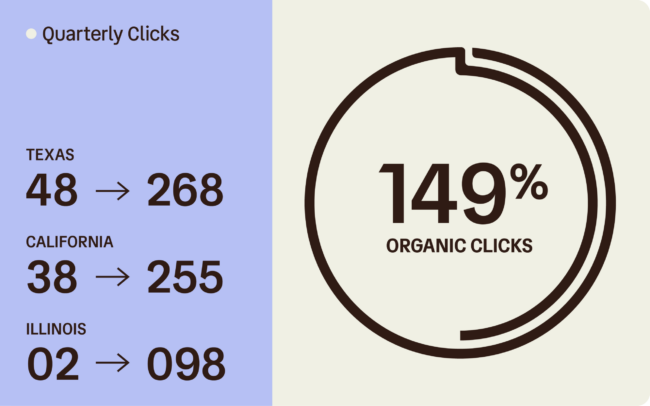
- Organic clicks grew from 703 to 1,750, up 149%
- Click-through rate more than doubled, from 0.4% to 1.0%
- Average position improved from 31.8 to 18.2, moving off page 3 and onto pages 1 and 2
- Impressions held steady (157K to 169K) while clicks soared: the section isn’t just being seen more, it’s being chosen more
The state pages drove the growth. Year over year, quarterly clicks to the Texas page rose from 48 to 268; California from 38 to 255; Illinois from 2 to 96; Georgia from 18 to 82; Colorado from 9 to 67.
Rankings (Ahrefs, July 2026 vs. July 2025) tell the same story from the SERP side:
- “Virtual iop near me” at position 1, up from 6
- “Virtual iop texas” at position 1, up from 9
- “Online iop mental health” at position 1, up from 7
- “Iop near me mental health” at position 1, newly ranking
- “Best virtual iop programs” at position 1, held
- “Telehealth iop” jumped from 48 to 6; “iop colorado” from 31 to 4; “iop online” from 14 to 3; “virtual iop programs” from 16 to 6
Note the pattern in what wins: state-qualified and “near me” searches, the highest-intent queries in the category, the ones made by people ready to enroll. That was the strategy. Rather than spending the year fighting every national provider for one broad head term, the architecture claimed the searches where a licensed program and a searching family can actually find each other.
One more signal worth noting, because it points at where search is going: the site now receives measurable referral traffic from AI assistants, and the virtual IOP pages are among the pages those visitors land on directly. In one recent month, sitewide sessions arriving from tools like ChatGPT grew 25%, with conversions from those visits growing alongside. Structured, genuinely local, well-organized content turns out to be exactly what AI assistants cite, too.
Why architecture wins in regulated categories
This engagement is a case study in a principle we keep returning to: your site’s structure should mirror the real-world structure of your business.
Healthcare, legal services, insurance, home services: in every regulated or licensed category, the delivery of the service is bounded by geography even when the service itself is digital. Search behavior follows those bounds. A site that acknowledges them (with real pages, real local substance, and accurate structured data) gives both Google and the searcher what a national brochure page never can: a direct answer to “can you help me, here?”
It also compounds. New states slot into the architecture as the program expands. Service lines extend within each state. And the same clarity that wins traditional rankings is now winning citations in AI-generated answers, the next front in search visibility.
Serving multiple states? rank like it.
If your organization delivers care, services, or expertise across state lines, virtually or in person, and your website still speaks to the whole country from a single page, you’re invisible in the searches that matter most.
Astute designs search architectures for multi-state and regulated businesses: keyword-mapped page structures, content that meets both compliance and human needs, healthcare-appropriate schema, and the ongoing measurement to prune and expand the portfolio as demand shifts.
Good to Know
FAQs About Multi-State and Telehealth SEO
Why do telehealth services need state-specific pages?
Because telehealth is licensed state by state, and search reflects that. People qualify their searches geographically (“virtual iop texas”), and Google localizes even unqualified searches (“virtual iop near me”). A page dedicated to each state is eligible for those searches in a way a single national page is not, and it can address state-specific insurance, licensing, and availability questions that determine whether a visitor can actually become a patient.
Isn’t creating many similar location pages risky for SEO?
Only if the pages are thin copies. Google’s quality systems target templated pages with no unique value, not local architecture itself. Each page needs real, differentiated substance: state-specific programs, insurance and availability details, relevant FAQs, and accurate schema. In this engagement, pages were also monitored and pruned. One underperforming page was removed and redirected, which keeps the whole section’s quality high.
What schema should healthcare pages use?
At minimum: MedicalOrganization for the provider, Service for the specific care being offered, FAQPage for question-and-answer content, and BreadcrumbList to express the site’s hierarchy. Schema doesn’t rank a page by itself, but it removes ambiguity about who offers what, where. That matters in a category where trust and precision are everything.
How long did results take?
The pages launched in May and June 2025 and built steadily: within a year, section clicks were up 149% year over year and multiple queries reached position 1. Local-intent pages in a focused category often show early wins within weeks, but the compounding gains (top-3 rankings, AI citations, section-wide authority) accrue over quarters.
Do AI assistants really send treatment-seeking traffic?
Yes, measurably. In this engagement, the site’s sessions referred by AI assistants grew 25% in a single recent month, some converting into contact events, with state-specific program pages among the direct landing pages. AI assistants tend to cite content that’s structured, specific, and unambiguous about geography and services, which the architecture provided.
Does this approach work outside healthcare?
Yes. It works anywhere service delivery is bounded by geography or regulation: legal, insurance, financial services, education, home services. The principle is the same: build pages that answer “can you help me, here?” for every place the answer is yes.


