Industry
HealthcareUsing A/B testing across a 6-week email campaign to learn which messaging was most effective at moving people from awareness to course completion, then using those insights to improve the campaign.
Most email calendars answer one question: what are we sending, and when? That solves the scheduling problem, but scheduling is the easy part. The more valuable work is learning how an audience responds to different ways of framing the same message.
Small shifts in framing, wording, or emphasis can change what captures someone’s attention and what moves them to act. Testing those differences turns each send into a chance to learn more about the audience and make the next decision with better information.
Those findings can inform landing page copy, paid ads, website messaging, and future campaigns built for the same audience. Here’s how we structured a campaign to generate those insights, and how we put them to use once we had them.
Table of Contents
At a glance
- A healthcare non-profit backed by a statewide medical association engaged Astute to promote a continuing education course tied to a state prescribing education requirement.
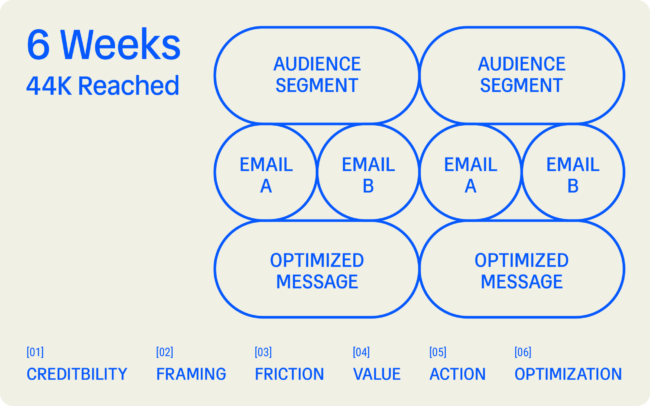
- The six-week campaign reached roughly 44,000 licensed professionals, divided into two audience segments based on license type.
- Within each segment, we tested two distinct messaging angles at a time, choosing questions based on what was most relevant to that audience.
- Each result gave us a clearer read on which benefits, barriers, and points of emphasis were most likely to get that segment’s attention.
- Those insights helped shape the emails that followed and informed social ads, print materials, landing page messaging, and other campaign creative.
- Additional email campaigns responded to where each person was in the process, including renewal-driven outreach and reminders for people who registered but hadn’t completed the course.
- The final send applied what we had learned throughout the campaign, turning five weeks of testing into a stronger message for each audience.

The client: two audiences, one renewal requirement
Prescribers in the client’s state must complete a set number of hours of education on controlled-substance prescribing in order to renew their medical license. Our client offered a grant-funded free course that satisfied that part of the renewal requirement. The people who need those courses fall into two groups holding different licenses and answering to different boards: advanced practice nurses and physician assistants on one side, physicians, dentists, and other prescribers on the other.
That distinction matters more than it looks. The requirement is nearly identical for both groups, but the wording differs. The difference in terminology comes down to which licensing board and which professional organization governs each profession.
The campaign is split into two audiences based on license type, which lets us tailor the testing to what is most relevant to each group. Rather than testing the same messages across both, we can test different assumptions about what each audience values.
For example, promoting a free course may matter more to professionals who typically pay for continuing education themselves than to those whose employers cover the cost. Each test helps us learn which messages actually resonate with that audience and refine the campaign around those findings.
How we structure an A/B testing calendar
Each week isolates a single question, written down before the send:
- Week one, credibility. What gives the course more weight with each audience: who is behind it, who endorses it, or how directly it connects to their work?
- Week two, framing. What makes the requirement feel more worth acting on now: staying ahead of an obligation or getting a task off the list?
- Week three, friction. What is most likely to stand in the way of enrollment for each audience, and which message does the best job of reducing that barrier?
- Week four, value. Which part of the course feels most relevant to the audience, from the clinical skills it builds to the problems it helps them handle in practice?
- Week five, action. Once the message is established, what call to action gives people the clearest reason to take the next step?
- Week six, optimization. We stop testing and build the final send around what the previous weeks taught us about each audience.
Every subject line was built around a deliberate messaging choice, so each winner gave us a clearer read on what this audience responds to. Those insights could then shape the rest of the campaign and strengthen how the course was marketed across other channels.
Across both audience segments, each test compared two intentionally different messaging approaches. The results showed which angles, words, and points of emphasis resonated most with each group, giving the client a clearer sense of how to position the course for different audiences and where to focus future marketing efforts.
How email test results strengthened other marketing efforts
The value of testing grows once the results start to inform the rest of the campaign. Each result gives us a clearer signal about which ideas deserve more emphasis and where they’ll have the greatest impact.
Extend the Strongest Angles Across Channels
In an ad, the first word or phrase has to earn the next second of attention. People scroll quickly, skim headlines, and make near-instant decisions about what is worth reading, so the message you lead with matters as much as the message itself.
That’s where messaging testing becomes especially useful. If credibility, convenience, clinical relevance, or another angle consistently gets a stronger response, we know which idea has earned the right to lead. We can then bring that emphasis into social ads, print materials, landing pages, and other campaign creative, adapting the execution to the channel without losing the message that first got people to pay attention.
Match the Message to the Decision Point
The same person may need a different reason to act depending on where they are in the process. Renewal-based emails can emphasize urgency as the deadline approaches, while broader campaign emails can focus on the course’s value or relevance. Test results help us decide which messages have already earned a place in that conversation.
Apply What We Learn Where People Drop Off
Registration is not the finish line. For people who sign up but do not complete the course, follow-up emails can draw on the benefits and motivators that performed best during acquisition, then refocus them around finishing what they already started.
Build an Evidence-Based Messaging Framework
Taken together, the tests create a clearer picture of how different audiences respond to the course, which messages deserve more weight, and how that emphasis should shift by channel and stage. That gives the client a stronger foundation for future campaigns rather than starting from a blank page each time.
Lifecycle automation timed to the renewal window
Alongside the six-week sequence, two automated emails run continuously, triggered by each subscriber’s birthday rather than by the content calendar. One sends 30 days out, one sends 10 days out, and each is split by license type so the terminology stays correct. License renewal in this state tracks to the licensee’s birth month, which puts each message in front of a professional at the point in the year when the requirement is closest to the front of their mind.
The campaign creates a peak. The automation covers the rest of the year, and the framings that win during the campaign go straight into it.
Build a campaign that learns as it runs
Good campaign strategy should leave you with more than a set of performance metrics. It should give you a clearer picture of what your audience responds to and stronger direction for every marketing decision that follows.
Astute builds campaigns around that kind of learning. From A/B testing and segmentation to paid media, lifecycle emails, and supporting creative, we use each result to sharpen the next move and make the full campaign work harder.
Good to Know
FAQs About A/B Testing Email Campaigns
What is A/B testing in email marketing?
An A/B test splits an audience in two and compares one element, such as the subject line, while everything else stays the same. A multivariate test extends the idea to combinations of several elements, such as subject line paired with preview text or send time. Both work the same way underneath: competing versions go to a sample of the list, the response is measured, and the winner goes to everyone else. The difference is how many questions one send can answer, and how large a list needs to be to answer them well.
How many A/B tests do you need before the results mean anything?
One test tells you which email won on one day. A pattern across several tests, especially one that repeats on separate audiences, is where a reliable reading begins. Any single result carries the fingerprints of that day’s timing, news cycle, and inbox competition. This is why we design campaigns as sequences rather than as a series of separate events.
Why run the same A/B test on two audiences?
Replication. When two independent lists respond the same way to the same test in the same hour, the odds that the result is noise drop sharply. When they respond differently, you have learned something about the gap between the two groups that no single test could have surfaced. For an audience that is already segmented, this costs nothing extra.
Can email A/B test results be used in paid ads and on landing pages?
Yes, and that is much of the point. Email produces large samples at low cost, which makes it a practical place to test messaging questions that would be expensive to answer in paid media. Winning framings become ad headlines, landing page headlines, and content topics. Carry them into the next channel as tested hypotheses rather than guarantees, since inbox behavior and search behavior are not identical.
What should you A/B test first?
Start with the questions whose answers change more than one thing. Testing an emoji tells you about that email. Testing whether an audience is moved by obligation, cost, convenience, or professional benefit tells you how to talk to them everywhere. Big framing questions first, refinements after.
Is your email program producing results, or producing findings? Talk with Astute.