
What Astute clients get from monthly reporting, and why the right metrics matter more than more metrics
Most agency reports answer the wrong question. They answer “what happened,” usually at length, and leave the client to work out what it means and what to do about it. The result is a document that gets skimmed once and filed.
We built our monthly reporting around a different standard. Every report ties the numbers to the outcomes a client actually cares about, follows up on what we did last month, and lands on what we’re doing next. Less data for its own sake, more answers.
Table of Contents
At a glance
- Metrics tied to outcomes. We agree up front on what success looks like for each client, then report against it.
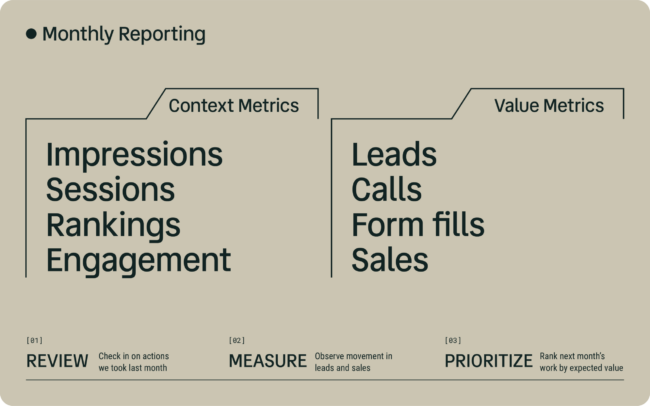
- Value over vanity. Leads, calls, form fills, and sales come first. Traffic and rankings matter when they move those numbers.
- Every number is interpreted. Figures come with a plain-language read on what they mean for the business.
- Last month’s work gets followed up. We report on the actions we already took and whether they paid off.
- Every report ends in priorities. A short, ranked list of what we’re tackling next month, and why.

The right metrics for the right outcomes
Not every client needs the same report. A home services company measuring booked calls, a treatment provider measuring admissions inquiries, and an ecommerce brand measuring revenue are chasing different outcomes, so their reports shouldn’t look identical.
We start by tying each channel to the outcome it’s supposed to drive, then report on the metrics that actually reflect progress toward it. Organic, paid, and AI search are all on the table, but the emphasis follows the goal, not a template.
Value metrics first, vanity metrics second
Sessions, impressions, and rankings are easy to report and easy to inflate. They’re also rarely what a client’s leadership is asking about. What they want to know is whether marketing is producing leads and sales.
So that’s where our reports start. Traffic metrics still show up, but as context: they help explain why lead volume moved, rather than standing in for it.
This is also where breaking the data down earns its keep. For one home services client, location pages drove a modest share of organic traffic but a far larger share of organic conversions, converting many times better than the blog. A site-wide traffic number would have hidden that completely, and it pointed straight at the next move.
Following up on what we already did
A report that only looks forward makes it easy to lose track of what was actually done. Each month, we circle back on the previous month’s actions: what shipped, what it moved, and what still needs time.
That keeps the work accountable. If something worked, we build on it. If it didn’t, we adjust, rather than quietly moving on to the next idea.
Prioritizing the month ahead
Every report closes with a short, prioritized list of what we’re working on next, each item backed by the data that justifies it. It’s not a summary. It’s a plan, and it’s built so a client can forward it to their leadership and have it stand on its own.
Keeping an eye on AI search
AI tools like ChatGPT are sending real visitors to client sites, and those visitors tend to land on specific, high-intent pages. Where it’s relevant, we track AI referral traffic alongside the other channels and look at what it produces, not just how much of it there is. That gives clients a baseline now, before the channel matters at scale.
Why it matters
A report is not a deliverable. It is the mechanism by which a client decides where the next dollar goes.
When reporting is a data dump, those decisions get made on instinct or on whichever number happens to look alarming. When reporting is tied to real outcomes, follows up on past work, and ends in clear priorities, the monthly review stops being a status update and becomes a planning session.
Want reporting you can actually act on?
If your monthly report is a folder of screenshots or a dashboard link nobody opens, you are paying for data collection instead of insight.
Astute builds monthly reporting around the metrics that matter to your business, follows up on the work already done, and closes with priorities your team can act on.
Good to Know
FAQs About Marketing Reporting
What should a good monthly marketing report include?
It depends on the business, but every report should connect marketing activity to real outcomes like leads and sales, explain what the numbers mean, follow up on last month’s actions, and close with clear priorities for the month ahead.
What’s the difference between vanity metrics and value metrics?
Vanity metrics, like impressions, sessions, and rankings, look good in a chart but don’t tell you whether marketing is working. Value metrics, like leads, calls, form submissions, and sales, tie directly to revenue. Good reporting leads with value metrics and uses the rest as supporting context.
Why does segmentation matter more than site-wide metrics?
Because averages hide the patterns that drive decisions. Breaking performance out by page type or site section often shows that a small slice of the site produces a large share of the conversions. A site-wide number shows none of that.
Why follow up on last month’s work?
Because it’s the only way to know what’s actually working. Checking in on past actions keeps the strategy honest, makes it easy to double down on wins, and stops underperforming ideas from lingering.
How should AI search traffic be reported?
As its own channel, with a focus on which pages AI tools send visitors to and what those visitors do once they arrive. Volumes are still modest for most businesses, so the pattern matters more than any single month.


