
Services
SEOPeople don’t search for “outpatient centers.” They search for IOPs and PHPs, in their city. We built the pages that answer them.
Behavioral health has a vocabulary problem that turns out to be a search opportunity.
The people looking for structured outpatient treatment, or the therapists, case managers, and families guiding them, don’t search in generalities. They search in the industry’s own acronyms: IOP (intensive outpatient program) and PHP (partial hospitalization program). And because treatment is something you attend in person, several times a week, they search locally: “iop dallas,” “php houston,” “partial hospitalization program atlanta.”
Our client, the outpatient arm of a nationally recognized behavioral health treatment provider, operates centers in nine metros across the country. Each metro had a location page. What no metro had was a page for the programs, the exact things people search for. For queries like “php dallas,” the provider was effectively invisible, ranking on page 2 and 3 while directories and competitors took the clicks.
Starting in July 2025, we fixed that. One metro, one program, one page at a time.
Table of Contents
At a glance
- Dedicated IOP and PHP pages for nine metros (Dallas, Houston, Austin, Atlanta, Chicago, Denver, the Phoenix area, Silicon Valley, and Las Vegas) rolled out in monthly batches through the second half of 2025
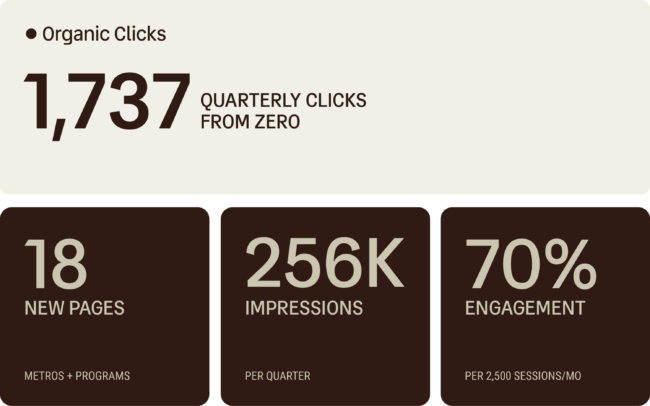
- From zero to more than 1,700 organic clicks per quarter: pages that didn’t exist a year ago now earn 924 quarterly clicks across the IOP set and 813 across the PHP set, on more than 250,000 impressions
- “PHP dallas” went from position 25 to position 1. “PHP houston” from 16 to 2. “PHP denver” from 13 to 2. “Atlanta php” from 41 to 5. “Intensive outpatient program phoenix” from 81 to 7
- An educational comparison layer, including IOP-vs-PHP content, wired into every page’s internal linking, meeting searchers who don’t yet know which level of care they need
- The locations section now draws roughly 2,500 organic sessions a month with a ~70% engagement rate, generating tracked contact events every month

The gap: cities without programs, programs without pages
The provider’s city pages did what city pages do: introduced the center, the team, and the setting. But program-intent searches are different from location-intent searches. Someone typing “php houston” isn’t browsing for a treatment center. They’re looking for a specific, clinically defined level of care, and they need to know: Do you offer it? Here? For what conditions? Covered by what insurance?
A general city page can’t answer that with the depth Google’s results demand, not when specialized directories and program-specific competitor pages are the alternative. The data reflected it: for program-qualified searches across nine metros, the provider was scattered across positions 13 to 81. In search terms, that’s not just underperforming. That’s absent.
The architecture answer was straightforward: give every program in every metro its own page, nested under the city it belongs to (/locations/[city]/iop/ and /locations/[city]/php/), so each page inherits the city’s context while owning its program’s keywords.
The build: eighteen pages, shipped in monthly batches
Beginning in July 2025, we researched, wrote, and launched dedicated IOP and PHP pages metro by metro. Atlanta and Dallas came first, then Denver, Austin, Chicago, and onward, each with:
- Program-specific substance: what the IOP or PHP involves at that location, session schedules and time commitment, conditions treated, and how the program fits into a continuum of care
- City-specific context: the local center, its team, and practical details a prospective patient in that metro actually needs
- Insurance and admissions clarity, the deciding factors for most families
- Deliberate internal linking, connecting each program page to its city hub, its sibling program, and educational comparison content, including IOP-versus-PHP material for the many searchers who don’t yet know which level of care fits their situation
That last layer matters more in this category than almost any other. Level-of-care decisions are confusing precisely when people are least equipped to untangle them. Pages that teach the difference, and then route the reader to the right program in their city, serve the searcher and the rankings at the same time.
The results: owning the program searches, metro by metro
A year after the first pages launched, the numbers highlight a valuable section of the site that simply didn’t exist before (Google Search Console, most recent quarter):
- The nine IOP pages: 155,000 impressions
- The PHP pages: 101,000 impressions
Rankings (Ahrefs, July 2026 vs. July 2025) tell the sharper story:
- “PHP dallas” at position 1, up from 25
- “PHP houston” at position 2, up from 16
- “PHP denver” at position 2, up from 13
- “Partial hospitalization program houston” at position 3, up from 17
- “Atlanta php” at position 5, up from 41
- “Intensive outpatient program phoenix” at position 7, up from 81
- “IOP program chicago” at position 7, up from 30
And the traffic behaves like the high-intent traffic it is: the locations section now sees roughly 2,500 organic sessions a month at a ~70% engagement rate, producing tracked conversion events (calls and form submissions) every month, with the Dallas, Austin, and Atlanta pages among the top contributors.
Why the acronym is the strategy
There’s a copywriting instinct to avoid jargon. In healthcare SEO, that instinct can cost you the exact moment of highest intent.
“IOP” and “PHP” aren’t insider shorthand to the people who matter. They’re the terms referring therapists use, the terms insurance plans list, the terms a discharging hospital hands a family on a printed sheet. When someone searches the acronym plus a city, they are as close to enrollment as a searcher gets. Pages built around those terms, with real clinical substance behind them rather than keyword wallpaper, meet the searcher at the moment the decision is being made.
The deeper principle is the same one that runs through all of our architecture work: build a page for every real intersection of what you offer and how people look for it. City alone isn’t enough. Program alone isn’t enough. The intersection (this program, this city) is where the searches, and the patients, actually are.
Have programs your website doesn’t talk about?
Most multi-location service organizations have this gap somewhere: real capabilities that never got their own pages, searched for in words the website never uses.
Astute finds those intersections with real query data, builds the architecture and content to own them, and measures the results page by page, in healthcare and other regulated categories where precision and trust aren’t optional.
Good to Know
FAQs About Program-Level Local SEO
What’s the difference between a location page and a program page?
A location page introduces a place: the center, its team, its setting. A program page describes a specific service delivered at that place, matching queries like “iop dallas” or “php houston.” Program-intent searchers need clinical specifics, schedules, and insurance answers that would bloat a general city page. Nesting program pages under city pages (/locations/city/program/) lets each do its job.
Why do IOP and PHP acronyms matter for treatment SEO?
Because they’re the vocabulary of the referral chain. Therapists, hospitals, and insurers all use IOP and PHP as standard terms, so high-intent searches use them too. Ranking for “php [city]” puts a provider in front of people who already know the level of care they need, which is the closest thing to bottom-of-funnel search that exists in behavioral health.
How long does it take new local program pages to rank?
These pages went from nonexistent to owning their keywords within two to four quarters. “PHP dallas” reached position 1 within a year of launch. Early movement often shows within weeks, but competitive metro rankings consolidate over months as the pages accumulate engagement signals and internal authority.
Should pages be rolled out all at once or in batches?
Batches, in most cases. This rollout shipped monthly from July to December 2025, which allowed each batch to be indexed, measured, and refined before the next, and avoided the scaled-content footprint of publishing eighteen templated pages in a day. What matters is that every page carries genuinely differentiated substance, whatever the pace.
How do you serve searchers who don’t know whether they need an IOP or a PHP?
With comparison content built into the architecture. Explainers on the difference between levels of care, linked from every program page, catch earlier-stage searches, educate the family or referrer, and route them to the right program in the right city. Education and conversion aren’t separate content strategies; they’re stops on the same path.
Does this approach generate actual admissions inquiries, not just traffic?
Traffic quality shows in engagement and contact behavior. Here, the location section sustains a roughly 70% engagement rate and produces tracked calls and form submissions every month, consistent with what program-plus-city queries are: searches made at the point of decision.


