
Services
SEOFrom stagnant organic traffic to a full-funnel marketing engine: SEO, brand, collateral, and advertising for High Tide Technologies
Some agency engagements are projects. This one became a partnership.
High Tide Technologies is a national, end-to-end cloud-based SCADA company. Its systems let water and wastewater operators monitor and automatically control infrastructure through field units connected by satellite, cellular, or Ethernet. It’s a technical product, sold to technical buyers, in an industry where trust is earned slowly and vendors are rarely household names.
When High Tide first came to Astute, the assignment was narrow: their organic growth had stalled, and they needed SEO help. Over the years that followed, the engagement grew into something much larger, spanning content, brand, collateral, and digital advertising. Over that same period, the company more than quadrupled its revenue.
Table of Contents
At a glance
- Hired for SEO, expanded into content creation, branding, collateral, and digital advertising over a multi-year partnership
- A long-form content engine built to own the SCADA industry’s search landscape, paired with technical SEO and optimized product and service pages
- A complete rebrand built on a Jungian archetype workshop (the Hero, the Sage, and the Citizen) with brand guides, swag, and a full print collateral system
- Digital advertising layered on top of the inbound foundation: Google Search, Display, and social campaigns with refined audiences and geo-targeting
- The company more than quadrupled its revenue during the partnership

Starting where it hurt: stagnant organic growth
High Tide didn’t come to us asking for a brand. They came with a plateau: organic traffic had flatlined, and in a niche B2B category, organic search is where buyers do their homework.
Our approach was content-heavy by design. SCADA buyers (municipal operators, utility engineers, system integrators) research deeply before they ever talk to sales. So instead of chasing quick technical fixes alone, we built a strategy around extremely detailed long-form content: educational resources designed to genuinely teach the reader while systematically covering the keyword territory the industry searches.
Three content layers worked together:
- Long-form educational content that positioned High Tide as the industry’s teacher, capturing the informational searches where buying journeys begin
- Customer case studies that documented real deployments, providing social proof that also built referral pipelines
- Optimized product and service pages so that when buyers moved from research to vendor evaluation, High Tide owned those results too
Technical SEO ran underneath all of it (best practices, site health, and structure) so the content had a sound foundation to rank from. The organic plateau broke, rankings climbed across a wide set of industry terms, and traffic turned into leads.
Earning the bigger assignment: the rebrand
Good design is good business, and High Tide’s leadership recognized it early. As the SEO partnership proved itself, the engagement expanded to the brand.
We ran brand workshop sessions with the leadership team and applied Jungian archetype analysis, the same strategy-first discipline we bring to every identity project. Three archetypes emerged as the pillars of the company:
- The Hero: the company that shows up and solves the hard problem
- The Sage: the teacher, matching the educational strategy already winning in search
- The Citizen: the everyman’s commitment to community and dependability, fitting for a company whose product quietly protects public water systems
From that foundation we built a modern identity. Modern without being fancy, designed to keep customers and distributors front of mind rather than chase design trends. Brand guides documented the system so it could be applied consistently everywhere the company showed up.
And it showed up everywhere: business cards, brochures, labels, spec sheets, inserts, infographics, print ads, notecards, branded swag, and tradeshow booth wraps. In an industry that still does real business on tradeshow floors, print isn’t nostalgia. It’s a sales channel, and every piece carried the same brand.
Completing the funnel: digital advertising
With the inbound foundation strong and the brand rebuilt, we added the final layer: paid reach to audiences who hadn’t found High Tide on their own.
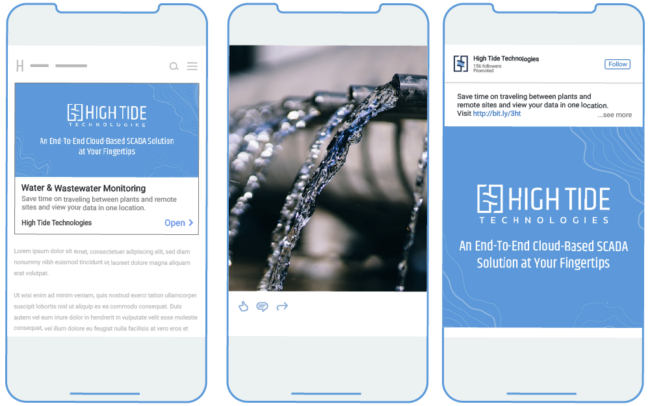
We launched Google Search and Display campaigns alongside social media advertising, using refined audience creation, geo-targeting, and messaging aligned with the brand voice the archetypes had defined. Because the organic and content foundation already existed, paid traffic landed on pages built to educate and convert. Advertising amplified a working system rather than compensating for a broken one.
The sequencing is the lesson. Ads came after inbound, not before. A paid click is expensive; sending it to a thin page wastes it. Sending it to the industry’s best content library doesn’t.
What compounds when one partner runs the whole system
Over the course of the partnership, High Tide Technologies more than quadrupled its revenue. Marketing never deserves all the credit for a result like that (the company builds an excellent product and closes its own deals), but the growth validated the decisions made at every stage: content before ads, strategy before design, education before promotion.
There’s a structural reason long partnerships outperform strings of projects. Every layer of this work reinforced the others: the archetype strategy shaped the ad messaging; the content strategy fed the case study program; the case studies armed the sales team; the brand system made every tradeshow booth and spec sheet feel like the website buyers had already read. None of that coherence happens when five vendors each own a fragment.
That’s what “leading their content, marketing, and branding initiatives” actually means in practice. Not a deliverable list, but accumulated context: an agency that knows the product, the buyers, and the industry well enough that year-five work builds on year-one decisions instead of replacing them.
Ready for a partner, not a project?
If your organic growth has stalled, or your marketing is scattered across vendors who’ve never spoken to each other, the fix usually isn’t another one-off project.
Astute builds full-funnel marketing systems for technical and B2B companies: SEO and long-form content that earns rankings, brand strategy that gives every channel one voice, and advertising that amplifies what’s already working.
Good to Know
FAQs About B2B SEO, Branding, and Full-Funnel Marketing
How does SEO work for technical B2B companies?
Technical buyers research extensively before contacting vendors, so B2B SEO is won in the education phase. That means deep, genuinely useful long-form content covering the questions engineers and operators actually ask, supported by technical SEO and conversion-ready product pages for when research turns into vendor evaluation.
Why is long-form content effective in niche industries?
In niche categories like SCADA, search volume per keyword is modest but intent is high and competition for quality content is thin. A detailed, authoritative resource can own its topic for years, ranking for dozens of related queries and earning trust that generic marketing copy can’t.
What do customer case studies do for a B2B company?
Two jobs at once: they’re social proof for prospects mid-evaluation, and they’re referral infrastructure, giving happy customers and distributors a concrete artifact to pass along. In this engagement, case studies were a core content layer alongside educational resources and product pages.
When should a B2B company invest in rebranding?
When the company’s actual quality outpaces how it presents, a common condition in technical industries where product investment runs years ahead of marketing. A strategy-grounded rebrand (archetypes and positioning first, visuals second) aligns the impression with the reality, across every touchpoint from the website to the tradeshow booth.
Should digital advertising come before or after SEO and content?
After, in most B2B cases. Paid campaigns perform dramatically better when they land on strong, education-rich pages, and the audience insights from organic search sharpen paid targeting. Building inbound first means every ad dollar amplifies a working system.
What are the benefits of a long-term agency partnership over one-off projects?
Compounding context. A partner who has run your SEO, brand, and advertising for years makes each new decision with full knowledge of what came before, so strategy stays coherent, work builds on itself, and nothing gets rebuilt from scratch with every engagement.


