Industry
Home ServicesServices
AI Search OptimizationStructured data, cleaner page architecture, stronger content, and original photography, applied across a home services brand’s electrical, HVAC, and plumbing pages so AI answer engines could find, understand, and cite the work.
AI answer engines cite very few sources per response. Being the third or fourth best page on a topic means being invisible in the answer entirely. So when a company’s pages are hard for a model to parse, the model does what a confused search engine does: it reaches for someone clearer.
That was the opportunity at a regional home services company offering electrical, HVAC, plumbing, and related home services across a U.S. metro. The site had real depth and genuine expertise. What it lacked was pages built for how AI engines actually read: unambiguous structure, machine-readable context, and substance a model can lift and attribute with confidence.
Table of Contents
At a glance
- A regional home services company with electrical, HVAC, plumbing, and related service lines
- The work: added location and service schema to service-by-location pages, rebuilt the structure of those pages, rewrote the on-page content for the electrical, HVAC, and plumbing lines, and added original, proprietary photography
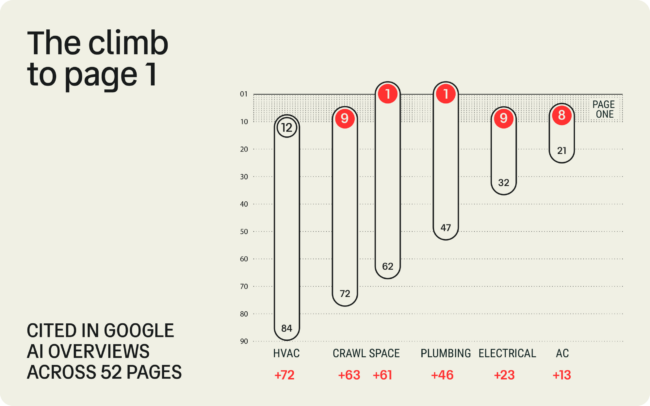
- The site is now cited in Google’s AI Overviews across 52 pages (137 citation links)
- Dozens of electrical, HVAC, and plumbing queries where the company appears in the AI Overview now rank in the top 3
- Representative position climbs between March and July 2026: a plumbing how-to query from 47 to 1, an HVAC air filter query from 84 to 12, an air conditioning query from 21 to 8, an electrical inspection query from 32 to 9, and a crawl space cluster from 62 to 1 and 72 to 9

The problem: expertise machines couldn’t read
AI engines and AI Overviews reward pages they can interpret without guessing. They want to know, quickly and unambiguously, what a business does, where it does it, and whether a given page answers the exact question a person asked.
This site made that harder than it needed to be. The service-by-location pages lacked structured data, so a model had to infer service and location from prose rather than read it directly. Page structure was inconsistent, which made the key answer on a page harder to extract. And thin, generic content gave models little worth quoting on the electrical, HVAC, and plumbing topics where buyers were actually searching.
The result was a site full of capability that AI answers routinely skipped.
The work: build pages AI can trust
The program focused on four moves, applied across the electrical, HVAC, and plumbing pages.
Location and service schema. We added structured data to the service-by-location pages so search and AI systems could read service and place directly, rather than guessing from copy. Removing that ambiguity is exactly what an answer engine needs before it will cite a source.
Rebuilt page structure. We reorganized the service-by-location pages so each one presented a clear, extractable answer to the question it targeted, supported by a logical heading hierarchy. Clean structure is what lets a model lift the right passage instead of skipping the page.
Stronger on-page content. We rewrote the content for the electrical, HVAC, and plumbing lines to genuinely answer the questions people ask, in specific and citable form. AI engines quote substance, not filler.
Original photography. We added proprietary images rather than stock, giving the pages authentic, ownable visual content that reinforces relevance and trust.
The results: cited in the answer, not just the index
The clearest signal is where the site now appears. It is cited in Google’s AI Overviews across 52 pages, with 137 citation links, and it holds a top-three position in a large set of the electrical, HVAC, and plumbing queries where an AI Overview is present.
The ranking trajectory on those AI Overview queries tells the same story. Between March and July 2026, high-intent electrical, HVAC, and plumbing queries where the company appears in the AI Overview climbed sharply:
- A plumbing troubleshooting query moved from position 47 to 1
- An HVAC air filter query moved from 84 to 12, and a related air conditioning query from 21 to 8
- An electrical inspection query moved from 32 to 9, and an electrical wiring query from 63 to 38
- A cluster of crawl space encapsulation queries moved from 62 to 1, 72 to 9, and 63 to 22
The pattern matters more than any single number. The pages that now win AI Overview citations are the ones rebuilt with clear structure, real substance, structured data, and original imagery. AI visibility followed the same work that strengthens traditional rankings, judged a little more strictly.
Why AI visibility is built, not bought
There is no trick that makes an AI engine cite a brand. Citations go to the clearest, most credible, most machine-readable answer on a question. That is a function of fundamentals: structured data that removes ambiguity, page structure that surfaces the answer, content worth quoting, and authentic assets that signal a real business behind the page.
Do those things well and both currencies pay out at once: better rankings, and a place inside the AI answer. Skip them, and no amount of AI-specific tactics will compensate.
Want to know whether AI engines can find and cite your business?
Most companies have no idea whether ChatGPT, Google’s AI Overviews, or Perplexity can identify them, cite them, or describe them accurately. Finding out, and improving it, is a measurable discipline.
Astute builds AI visibility on the same fundamentals that win search: structured data, clean architecture, genuinely useful content, and authentic assets, measured against real ranking and AI Overview data.
Good to Know
FAQs About AI Visibility
What is AI visibility?
AI visibility is how often, and how accurately, your brand and pages appear inside AI-generated answers, including Google’s AI Overviews and assistants like ChatGPT and Perplexity. Where traditional SEO measures your position on a results page, AI visibility measures whether you are named and cited inside the answer itself.
Does schema markup help with AI visibility?
Yes, indirectly but meaningfully. Structured data removes ambiguity about what a page offers and where, which makes it easier for AI systems to interpret and cite a page correctly. It does not force a citation, but it clears an obstacle that often prevents one.
How do you measure AI visibility?
Primarily through AI Overview presence and citation data (which keywords surface an AI Overview and whether the site is cited) alongside the ranking data for those same queries. Strong traditional rankings on a topic remain the best predictor of being cited in the answer.
How long does it take?
Ranking and AI Overview gains on optimized pages can begin within weeks, but the fuller picture builds over quarters as engines reprocess the improved structure, content, and schema.