
Most paid search accounts chase reach. This one traded reach for return, targeting a single high-intent slice of the market on purpose, and let a disciplined budget do the rest.
The instinct in Google Ads is almost always to expand: more keywords, more campaigns, more match types, more surface area. Robert B. Hill Co., a commercial and industrial water treatment company, wanted the opposite. The goal was not the most clicks or the widest footprint. It was the highest return from a narrow, high-value slice of demand: buyers actively searching for industrial water softeners.
That takes discipline, not scale. A narrow strategy only works if the account is managed tightly enough to spend on the right searches and nothing else. Astute manages the entire account to that standard.
Table of Contents
At a glance
- Client: a commercial and industrial water treatment company
- Service: full Google Ads account management
- Strategy: a single, deliberately scoped Search campaign built around high-intent industrial water softener searches, designed to maximize return rather than reach
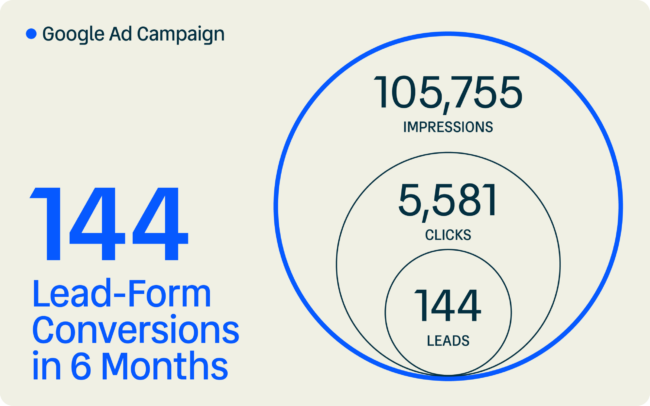
- H1 2026 spend: $93,166 across 105,755 impressions and 5,851 clicks
- Click-through rate of 5.53% at a $15.92 average cost per click
- 144 lead-form conversions at a $647 cost per conversion, a 2.46% conversion rate
- The campaign is limited by budget, meaning qualified demand currently outpaces spend
- Lead quality has improved alongside volume, per the account team

The goal: return, not reach
Water treatment is a high-consideration, high-value purchase. A single industrial order can dwarf the media cost behind it, which changes the math of a paid search program. Winning a large volume of cheap, loosely related clicks is not the objective. Winning the small number of people who are genuinely in-market for the specific systems the company sells is.
So the client set a clear mandate: keep the targeting narrow, concentrate spend on the highest-intent industrial water softener searches, and protect return rather than inflate volume. The challenge was to resist the constant pull toward broadening, and to make a tight keyword set produce real leads.
The work: one campaign, managed tightly
Astute runs the full account, structured around a single focused Search campaign rather than a sprawling set of loosely themed ones. That focus is the strategy, not a limitation.
The keyword set stays deliberately narrow and high-intent, centered on industrial water softener demand, with disciplined exclusion of the broad and off-target searches that would quietly drain a budget this concentrated. Bidding runs on Target CPA, so the account optimizes toward cost-efficient conversions rather than raw traffic. Ads and landing pages are kept tightly aligned to the searches they answer, which is what earns both the click and the conversion. Conversions are tracked on lead-form submissions, so the account is optimized against actual inquiries, not proxy metrics.
The result is an account where nearly every dollar is pointed at the same tightly defined, high-value audience.
The results: a tight set that converts
Concentration shows up first in relevance. A 5.53% click-through rate on Search is strong, and it is what happens when the keyword, the ad, and the landing page all answer the same specific intent. People searching for what the company actually sells are the ones clicking.
That relevance carries through to conversions. In the first half of 2026, the campaign produced 144 lead-form conversions at a 2.46% conversion rate and a $647 cost per conversion. For high-value commercial and industrial equipment, where a single closed order can far exceed the cost of the leads that produced it, that is an efficient number, not an expensive one. The client’s own CRM logged a comparable lead count over the same period, which confirms the tracking is sound.
Two signals matter beyond the raw totals. First, the campaign is limited by budget, which means qualified demand currently exceeds what the budget can capture. There is room to scale a program that is already efficient. Second, and most important to the client, lead quality has improved alongside volume. The narrow strategy is not just producing leads, it is producing the right ones.
Why narrow wins for high-value buyers
Reach is easy to buy and easy to mistake for progress. For a high-consideration purchase, the goal is not to be seen by everyone, it is to be the obvious answer for the few people ready to buy. That calls for a tightly defined keyword set, disciplined exclusions, bidding tuned to cost-efficient conversions, and ads and pages that match intent precisely.
Done well, a narrow campaign does not just spend less on the wrong clicks. It concentrates the entire budget on the audience most likely to become customers, which is what turns paid search from a traffic expense into a return.
Ready to build a paid search program around return, not just reach?
The widest campaign is rarely the most profitable one. A tightly managed, high-intent program can deliver qualified leads far more efficiently than a broad one, especially for high-value products and services.
Good to Know
FAQs About Paid Search
Should a Google Ads campaign target as many keywords as possible?
Not usually. Broad targeting spreads budget across searches with very different levels of intent, and much of it lands on people who will never buy. For high-value or high-consideration purchases, a narrow set of high-intent keywords, managed tightly, often returns far more than a wide one.
What does “limited by budget” mean, and is it a bad thing?
It means the campaign could capture more qualified traffic than the current budget allows. It is not a failure, it is a signal: the strategy is working well enough that there is profitable demand left on the table, and room to scale.
Is a high cost per lead a problem?
It depends entirely on what a lead is worth. A cost per lead that looks high for a low-ticket product can be very efficient for high-value equipment, where a single order can far exceed the media cost behind the leads that generated it.
How do you measure paid search success?
By leads and lead quality, not clicks. We track actual lead-form conversions and optimize toward cost-efficient, qualified inquiries, then work with the client to confirm those leads are the right ones.


