Website Accessibility
Remove the barriers standing between people and your website.
Strengthen accessibility across design and development while creating a clearer record of the work done.
Websites have to work beyond the default experience.
A website can look clear and still be difficult to navigate with a keyboard. It can pass an automated scan while forms, menus, or interactive features remain hard to use.
Accessibility, often abbreviated as a11y, requires attention to how the website looks, how it is built, and how people navigate it across different devices and assistive technologies.
We address accessibility in the design, the code, and the content.
What We Deliver
Text and layouts hold up under magnification
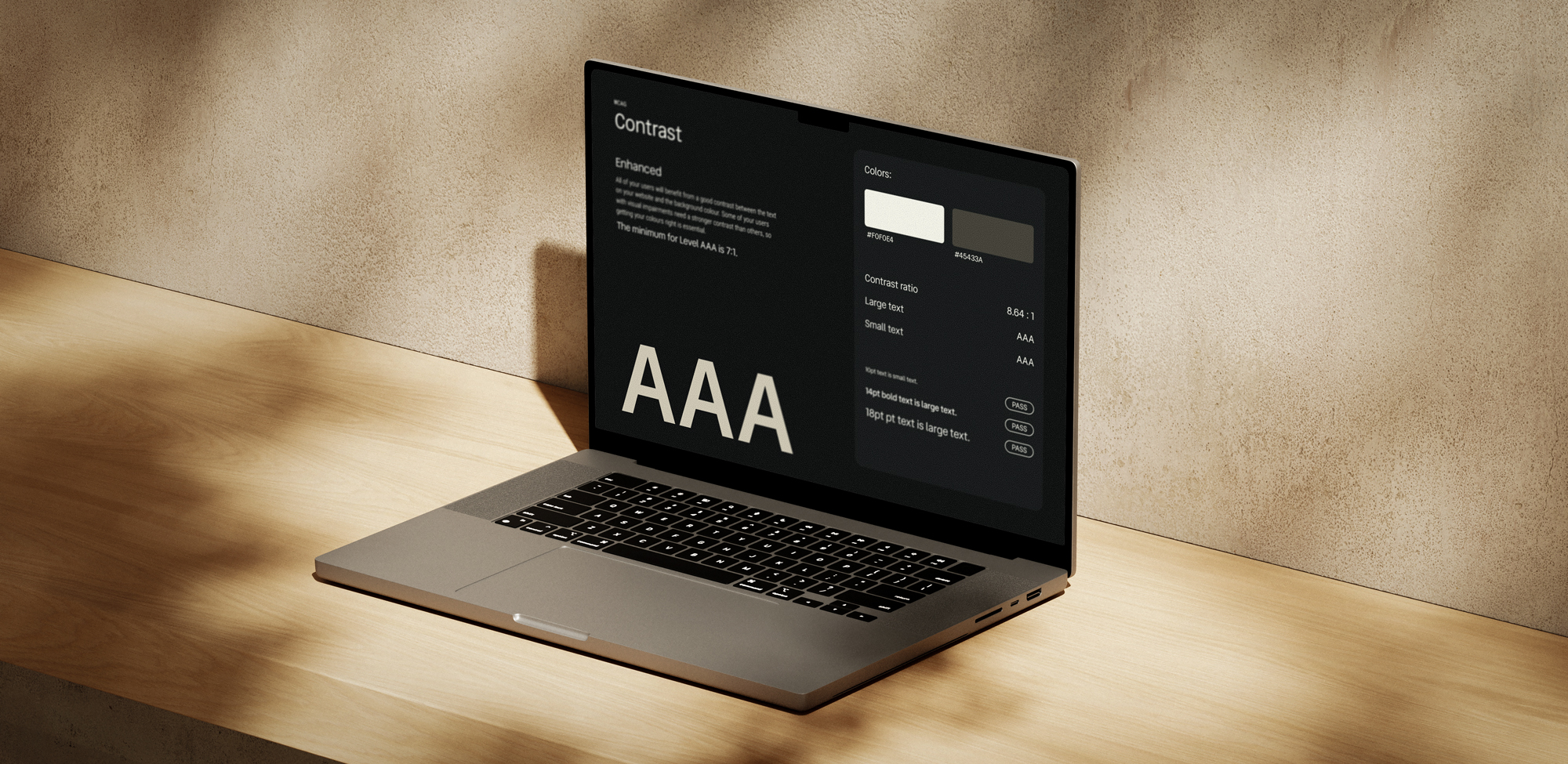
We review contrast, typography, spacing, and layout behavior so people can enlarge content without losing information or functionality. Visual hierarchy helps readers follow the page, while instructions use more than color to convey meaning.
Navigation works without a mouse
Menus, links, buttons, and interactive features need to work by keyboard. We address focus visibility, navigation order, and predictable behavior so visitors can tell where they are and reach what they need.
Assistive technology gets meaningful information
Semantic HTML and logical headings help screen readers communicate the page’s structure. Where complex controls need additional information, Accessible Rich Internet Applications, or ARIA, provides supporting labels, roles, and states. Native HTML remains the foundation.
Content makes sense beyond its appearance
Images need appropriate text alternatives, links need meaningful wording, and instructions shouldn’t depend only on position, shape, or color. We review these details so essential information doesn’t disappear when someone experiences the page differently.
Website accessibility takes work. We help your team manage it.
Finding an issue is only the beginning. Someone has to understand its impact, decide how to address it, and coordinate the fix. We bring that work together so your team can make informed decisions without managing every technical detail.
One team can take issues through to resolution
Accessibility fixes can involve design, development, and content at once. We coordinate those changes so your team doesn’t have to translate findings or pass requests between separate providers.
You understand what’s at stake
We explain how issues affect the things visitors need to do, such as navigating services, completing forms, or finding contact information. That gives your team useful context for decisions about budget and timing.
The scope reflects what the website needs
Some issues call for targeted repairs. Others point to problems with shared templates or features. We identify the extent of the work so you can plan resources and understand where a broader change may resolve multiple issues.
What a website accessibility engagement looks like
We define which markets, services, offers, and audience needs deserve paid coverage before deciding how the account should be built.
The scope depends on the website, the applicable requirements, and whether the work involves a new build, an existing site, or targeted remediation. We define the standard and review method before testing begins.
How It Works
Define the scope and benchmark
We identify the pages, templates, components, and user tasks included in the review. Many engagements use the Web Content Accessibility Guidelines, or WCAG, with WCAG 2.2 Level AA as the evaluation benchmark.
The Americans with Disabilities Act, or ADA, and Section 504 may create legal obligations depending on the organization and situation. They aren’t interchangeable with WCAG, and any compliance position should receive qualified legal or subject-matter review.
Audit the website
We combine automated scanning with manual review, keyboard testing, and screen reader considerations. Forms, menus, links, page structure, and interactive features are reviewed against the agreed scope.
Prioritize and remediate barriers
Findings are organized by severity, reach, and effect on important user tasks. Remediation may involve design changes, code updates, content revisions, or a combination of all three.
Validate the work and document next steps
Updated areas are reviewed again to confirm that the identified barriers were addressed. Remaining limitations, future recommendations, and responsibilities are documented so the work can continue after the engagement.
What We Do
Accessibility must be maintained as the website evolves.
Website Maintenance
A website can become less accessible when new content, templates, plugins, or features are added. Standards, browsers, and assistive technologies also continue to evolve.
Ongoing website maintenance can help protect the work through:
- Accessibility review for new pages and components
- Checks after design or functionality changes
- Continued attention to keyboard behavior and focus states
- Review of forms, labels, errors, and instructions
- Updates when plugins or platform changes introduce barriers
- Monitoring of evolving WCAG guidance and accessibility practices
Good to Know
Website Accessibility FAQs
What is website accessibility?
Website accessibility means designing, developing, and maintaining websites so people with disabilities can perceive, navigate, understand, and interact with them. It includes visual design, code structure, content, forms, navigation, and interactive features.
What does a11y mean?
A11y is a common abbreviation for accessibility. The “11” represents the eleven letters between the first “a” and the final “y.”
What accessibility standard do you use?
The evaluation standard depends on the engagement. Many website accessibility audits and remediation projects use WCAG 2.2 Level AA as the benchmark. The applicable version and conformance level should be confirmed when the scope is established.
Are WCAG, the ADA, and Section 504 the same thing?
No. WCAG provides technical accessibility guidelines. The ADA and Section 504 are laws that may apply in different circumstances. Meeting a WCAG benchmark and determining legal compliance are related but separate questions.
Does meeting WCAG 2.2 Level AA make a website ADA compliant?
WCAG 2.2 Level AA is commonly used as a technical benchmark, but ADA compliance is a legal determination. Accessibility claims and legal obligations should be reviewed by qualified legal counsel or another appropriate subject-matter expert.
Can an automated tool find every accessibility problem?
No. Automated tools can identify some technical issues, but they can’t fully evaluate usability, context, keyboard behavior, content clarity, or every assistive technology interaction. They also sometimes throw false flags. A thorough audit also requires manual review.
What is included in a website accessibility audit?
The scope may include automated scanning, manual page review, keyboard testing, screen reader considerations, and inspection of forms, menus, links, headings, and interactive features. The exact pages and components are defined before the audit begins.
Can you improve the accessibility of an existing website?
Yes, sometimes. There are many variables depending on how the website is built. We can audit an existing site, prioritize barriers, and remediate issues within the agreed scope. Some problems can be corrected directly, while others may require broader design, development, content, or platform changes.
Is accessibility included in website design and development?
Accessibility is always a consideration throughout our website design and development process. A dedicated accessibility engagement provides deeper evaluation, documentation, testing, and remediation against a defined standard.
How often should a website be reviewed for accessibility?
The appropriate schedule depends on how often the website changes and the level of risk involved. Reviews are especially useful after redesigns, platform updates, new templates, major content additions, or changes to interactive features.
Does website accessibility help SEO?
Some accessibility practices also support SEO, including semantic HTML, logical headings, descriptive links, and clearer page structure. Accessibility and SEO have different goals, however, and improvement in one doesn’t guarantee results in the other.
How long does a website accessibility audit take?
The timeline depends on the number of pages, templates, interactive features, testing methods, and reporting requirements. We establish the schedule after defining the audit sample and level of review.
Work With Us
Know exactly where your marketing stands. We’ll get to the root of it and shape the work from there.
Resources