


More and more people get their answer without clicking anything. They read the AI Overview at the top of Google, or they ask an AI assistant and act on what it says. The page that supplied that answer often gets no visit and no mention.
That raises the bar for what’s worth publishing. If your page repeats what twenty other pages already say, an AI system can assemble the answer on its own, and it has no reason to send anyone to you. If your page offers something those twenty don’t, it becomes a source worth citing.
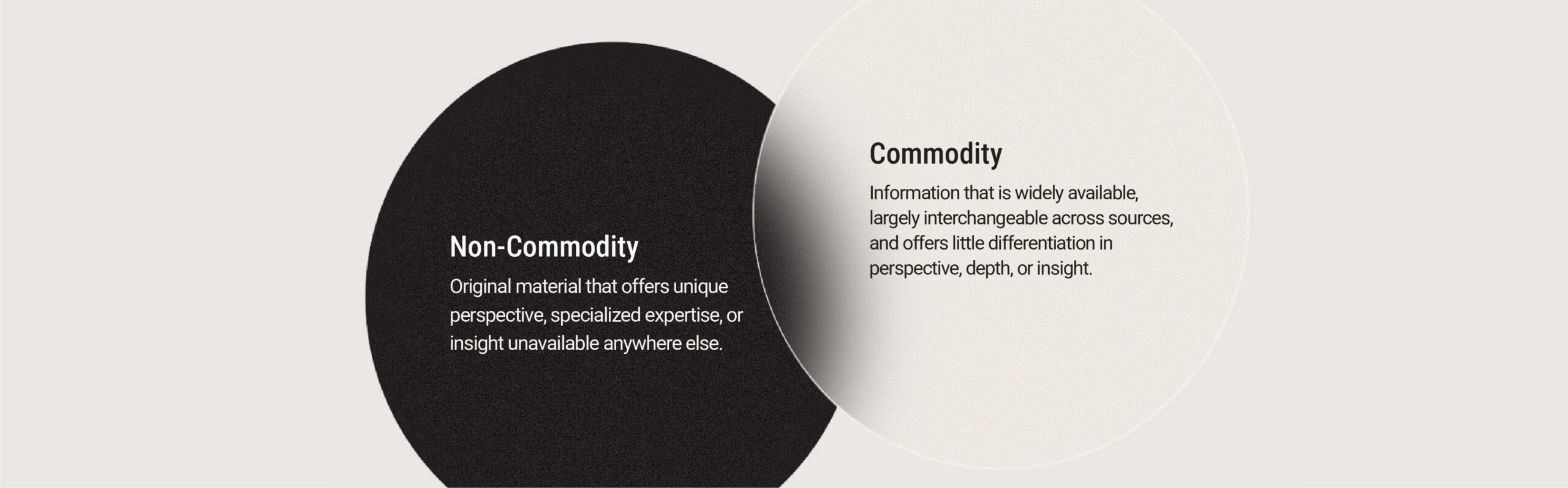
That difference has a name: commodity versus non-commodity content. Commodity content is the interchangeable kind. Non-commodity content is the kind only you could have written. Which one you publish increasingly decides whether you get cited in an AI answer or quietly absorbed into someone else’s.
One thing to keep in mind throughout: none of this is a separate set of AI tricks. AI search rewards the same qualities good search always has. It’s just far less forgiving of content that doesn’t have them.
What’s The Difference Between Commodity And Non-Commodity Content?
Commodity content answers a known question with information that’s widely available and broadly agreed upon. Non-commodity content carries something only your organization can provide: firsthand experience, a specific point of view, original analysis, or an answer shaped for a particular audience.
What Commodity Content Looks Like
The examples are easy to picture. “What is medication-assisted treatment?” A generic list of anxiety symptoms. A “types of therapy” overview that reads like every other one. The subject isn’t the problem. The problem is that dozens of sites can publish essentially the same answer. A reader may need the information. They don’t necessarily need it from you.
What Non-Commodity Content Looks Like
This is where a brand’s own experience shows up. An admissions team’s account of what actually derails someone’s first week in treatment. A clinician’s take on where standard advice breaks down. Program results framed for a specific population rather than the general public.
This isn’t a fringe framing. Google’s own guidance on optimizing for generative AI search leans on the same split, and even uses the words commodity and non-commodity content, contrasting a generic tips post with a specific, experience-based one.
Does Commodity Or Non-Commodity Content Win AI Overviews?
Non-commodity content does. An AI Overview’s job is to answer, and it names very few sources when it does. Commodity content gives it nothing to cite, because it can generate that answer on its own. Non-commodity content gives it something it can’t produce, and that’s what earns the reference.
In Our Experience
We’ve seen this play out across a network of behavioral health properties. The pages that get cited for specific questions are the ones built with genuine substance and clear architecture. Not coincidentally, they’re often the same local program and service pages that already rank well in traditional search. AI search isn’t a separate content universe. It’s a stricter judge of the same one.
The stakes change with that stricter judging. In classic search, being the third-best result still earns clicks on page one. In an AI answer that names one or two sources, third-best is invisible. This is where different targets carry different requirements. Commodity content can still earn visibility in traditional results and capture existing demand. An AI Overview that cites a single source simply sets a higher bar for what it will point to.
What Does Commodity Content Still Do Well?
Commodity content does real strategic work. It just rarely earns a citation on its own.
Captures Established Demand
People keep searching basic questions, and they always will. A clear foundational page can introduce your organization to someone who doesn’t yet have the words for their problem.
Someone asking “what is medication-assisted treatment” may not yet realize their real question is whether it’s right for a family member. Meet them at the plain-language question, and you’re the one already there when the harder question surfaces.
Gives Readers Necessary Context
A person can’t weigh a nuanced argument without understanding the basics first. Definitions and overviews build the shared vocabulary that makes your more advanced content usable. Skip that groundwork, and your most differentiated pages land on readers who aren’t ready for them yet. Commodity content is often what earns someone the ability to appreciate the non-commodity content behind it.
Strengthens The Content System
Foundational pages anchor topic clusters, open internal-linking paths, and route visitors toward more specific resources. Their value often comes from the role they play across the site more than the page itself.
A strong “what is” page can pass both authority and readers to the differentiated pages you actually want cited. Seen that way, commodity content isn’t the destination. It’s the connective tissue that helps the rest of the site perform.
Reduces Friction
Not every visitor needs a fresh insight. Sometimes they need a straight answer before they’ll take the next step, and a page that makes them hunt for it just sends them back to the results.
A clear, accurate overview removes that stall. It moves someone from “I’m not sure what I’m dealing with” to “now I know what to ask,” which is often the step that matters most.
Commodity Vs. Non-Commodity Isn’t The Same As Funnel Stage
If you plan content at all, you probably already sort it by upper or lower-funnel stage: awareness content for someone just learning about a problem, decision content for someone close to making a choice. Which is a useful way to think about content strategy because it’s a way to assign purpose to each page.
Following that thread, it might seem like the natural next step is to categorize commodity content as “top of the funnel” and non-commodity content as “bottom of the funnel.” However, this logic is flawed, and seems to be a commonly misunderstood aspect in the commodity vs. non-commodity content conversation.
The funnel stage tells you where a reader is in their search journey. Commodity versus non-commodity tells you whether the content itself is interchangeable or distinctive. Every page has both at once, and the two move independently.
Once you separate the two, a page’s funnel stage and its commodity status form a simple grid:
| Funnel Phase | Commodity | Non-Commodity |
| Awareness | “What is X” definitions. Easily replaced, easily absorbed into an AI answer. | Original framing of a common problem. Can earn attention and citations even early. |
| Decision | Generic “how to choose a provider” checklists. High intent, but interchangeable. | Real examples, processes, and outcomes. Hard for anyone else to reproduce. |
Both directions of that grid matter. A bottom-of-funnel “how to choose a treatment provider” post can be a pure commodity if it lists the same checklist as everyone else. A piece of original research can sit at the very top of the funnel and still be publishable nowhere else.
Where a page sits in the funnel and whether it’s commodity are two different questions, and only the second one decides what an AI answer does with your page.
When Does Commodity Content Become A Liability?
Commodity content turns into a liability when it’s published without a purpose beyond chasing search volume. That usually looks like:
- Targeting a keyword only because it has volume
- Repeating whatever already ranks
- Covering every subheading competitors use, for completeness alone
- Adding length without adding substance
- Publishing near-identical articles to manufacture topical authority
Google’s guidance is direct about that last one. Creating pages for every possible query variation, mainly to influence rankings or AI responses, runs into its scaled-content spam policy, and a high quantity of pages doesn’t make a site more relevant or more useful. Coverage isn’t the same as authority.
We’ve also seen the practical version of that. Thinning or upgrading a bank of similar pages tends to do more for visibility than adding more of them.
How Do You Make Content Non-Commodity?
You make content non-commodity by adding something a competitor can’t truthfully copy.
Apply Familiar Information To A Specific Audience
A generic “what is outpatient treatment” page is easy to replace. The same information written for working parents weighing outpatient care against time away from their kids is not. The facts may be common, but the framing, the examples, and the priorities are specific to an audience only you serve.
Bring Firsthand Observations And Named Expertise
Say what you’ve actually seen. A byline from someone who does the work, backed by a real bio, signals to readers, and to the systems reading on their behalf, who stands behind the claim. Firsthand detail is also the hardest thing for anyone else to reproduce, because they didn’t live it.
Develop A Genuine Point Of View
A clear stance, a decision framework, or an honest account of where common advice fails gives readers something they can’t get from a summary. It also gives them a reason to remember where they read it. A page that only echoes everything else on the topic is, by definition, replaceable.
Answer The Questions Competitors Skip
Go one layer deeper. Most pages stop at the obvious question and leave the harder one unanswered: the tradeoffs, the failure patterns, the “it depends, and here’s exactly on what.” That next layer is often the reason someone keeps reading, and the reason an AI answer has something specific to cite.
Keep The Fundamentals In Place
Clear structure, headings that map to real questions, and content that’s easy to follow still matter. Structured data isn’t required to appear in AI answers, and no markup guarantees a citation, but it remains worthwhile for rich results, which is one reason schema markup still earns its place in an overall SEO strategy.
How Does E-E-A-T Fit?
E-E-A-T helps establish whether a source should be trusted. Non-commodity content gives that source something worth trusting it for.
Google describes E-E-A-T as experience, expertise, authoritativeness, and trust, identified through a mix of signals rather than a single ranking factor, with trust the most important of the four. It gives even more weight to strong E-E-A-T on topics that can affect someone’s health, finances, or safety, the “Your Money or Your Life” category that most behavioral health content falls into.
Commodity content can still demonstrate E-E-A-T. A basic overview written or reviewed by a qualified clinician is trustworthy. But credentials alone don’t make information distinctive. Non-commodity content gives you more room to show experience: what you’ve seen, how you reached a conclusion, and where the exceptions are.
Does AI Make Commodity Content Useless?
AI doesn’t make commodity content useless. It makes commodity content on its own much harder to defend.
AI systems are good at synthesizing definitions, standard tips, and common comparisons. When twenty pages say the same thing, an AI response can satisfy the need without sending anyone to a specific page. Non-commodity content gives both readers and search systems something less interchangeable: a unique data point, a framework, a specific example, a credible firsthand take, a clear point of view.
None of this guarantees a citation. What it does is make your content source-worthy, which is the part you can actually control. Google frames it the same way: creating genuinely useful, non-commodity content will likely shape your presence in AI search more than any single tactic.
Key Takeaways
- Commodity versus non-commodity is a separate question from funnel stage. Treat them as two axes.
- Differentiation predicts citations. Funnel stage predicts intent and format.
- Commodity content still captures demand and builds context. It rarely earns a citation on its own.
- AI raises the cost of being interchangeable. Source-worthy content is the goal you control.
FAQs About Commodity Content vs. Non-Commodity Content
1. What Is Commodity Content?
Commodity content answers a known question with information that’s widely available and broadly agreed upon. Many sites can publish essentially the same answer, so a reader may need the information but doesn’t necessarily need it from you.
2. What’s The Difference Between Commodity And Non-Commodity Content?
Commodity content restates information that’s freely available anywhere. Non-commodity content adds something only its source can provide, such as firsthand experience, original analysis, a specific point of view, or an answer shaped for a particular audience.
3. Does Commodity Content Appear In AI Overviews?
Commodity information often appears inside AI Overviews, but usually as a summarized answer the AI assembles itself rather than a citation to a single page. Because AI answers name few sources, interchangeable pages have little reason to be referenced.
4. Is Non-Commodity Content Always Bottom Of Funnel?
Not necessarily. Differentiation and funnel stage are separate. Original research or an expert point of view can create awareness at the top of the funnel, and a high-intent page can still be commodity if it repeats the same information found everywhere else.
5. Does Non-Commodity Content Guarantee An AI Overview Citation?
Not on its own. Differentiation makes content more source-worthy, but citations are never guaranteed. Strong, well-structured, genuinely useful content improves your odds in both AI answers and traditional search.
Be The Source, Not The Summary
Ranking still matters, but it’s no longer the whole game. The answer at the top of the page now gets assembled from whoever gave it something worth citing, and interchangeable pages don’t make the cut. The brands that earn preference aren’t publishing more. They’re publishing what no one else could have written.
At Astute, we find where your content has gone commodity, sharpen the pages that should be getting cited, and build the architecture that keeps them findable across traditional search and AI answers. Contact us today to learn more about our services and how we help businesses adapt to ever-evolving algorithms to reach potential customers.